
Voyager: from system to artifact
a study in system design and lifecycle thinking
April 23, 2026
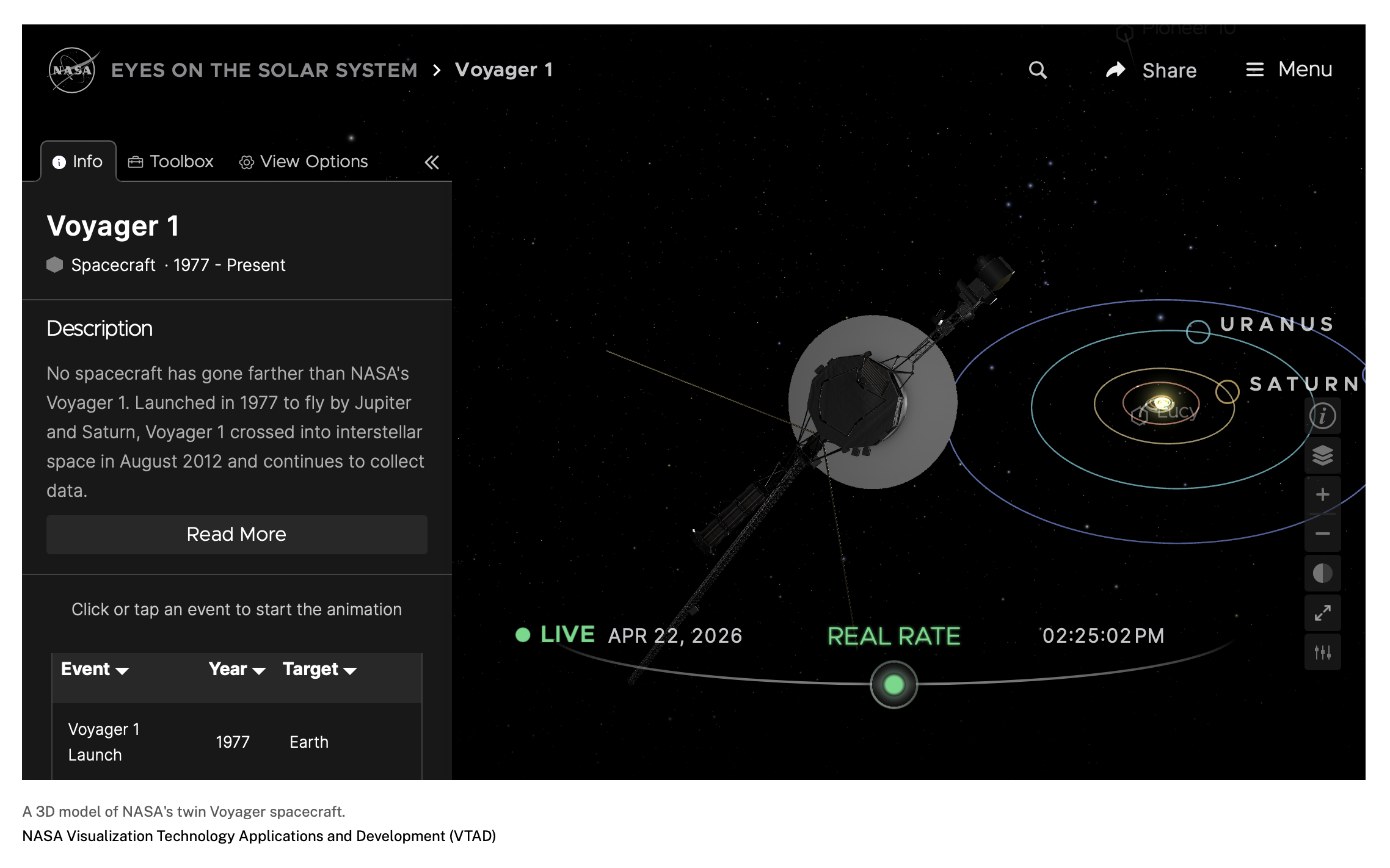
Voyager is often framed as a story of exploration. It is also a study in how signal is found, structured, and carried forward across decades. Originally launched in 1977, the Voyager probes remain the most distant human-made objects in operation. While Voyager is an apt name, it’s middle name should be Endurance.
Beneath the images and milestones sits something quieter. A system designed to reveal what matters, and to keep doing so long after its original intent. That distinction changes how the mission is understood.
The probes are not dying. They are being managed down. They are still transmitting from interstellar space. They are still returning value. Now operating under constraint to extend that contribution.
Voyager 1 extended outward, becoming our first interstellar sensor. Voyager 2 mapped the system, from Jupiter to Neptune. One carried insight beyond the system. One established coverage across it. This was not redundancy for safety. It was redundancy with intent. Divide roles. Expand coverage. Then go deep.
Designing beyond the planning horizon
Voyager was built for a five year mission. It is still operating nearly fifty years later. It continues to function under conditions never anticipated. It continues to produce insight under constraint. Durability and optionality have outperformed precision forecasting. The most valuable systems are not always those that predict the future with accuracy. They are the ones that continue to operate as conditions change.
Sequence determines value
Voyager did not optimize early. It discovered first. It mapped before it refined. It learned before it scaled. Breadth mapped the system. Depth extended what mattered.
In environments that are not fully understood, exploration precedes optimization. In environments that are well defined, optimization creates advantage. The challenge is knowing which condition you are in.
Questions worth asking
Are we rushing to monetize before we understand what we have built?
Are we scaling signal, or simply scaling noise?
Are we locking into efficiency in a system we do not yet understand?
Are we designing for speed when clarity is the real constraint?
From system to artifact
Every system reaches a point where performance is no longer the primary objective. Voyager is in that phase now. It is no longer expanding capability. It is revealing what remains. What remains still holds value. Not in output, but in what it can teach.
Artificial intelligence and high performance computing are compressing that cycle. We can learn faster. We can extract more. We can apply those insights sooner. The distance between experience and application is shrinking.
Clarity is not the removal of complexity. It is the structuring of it.
Designing what comes next
How we manage what remains matters. How we interpret what remains matters. How we transfer that learning forward matters. How we design for that transition matters.
Some systems should be extended. Some should be studied. Some should inform what comes next. Some should be allowed to conclude.
The question is not when a system ends. When systems plateau, how do we engineer what comes next with thought and purpose?
