
Quantum isn’t just accelerating. It’s aligning
April 21, 2026
(A strategist’s read on a physicist’s domain — with respect for the math, and full awareness that I’m simplifying a very deep field)
Over the last six quarters, something has shifted inside the quantum computing realm. Not just more announcements. Not just better qubits. The shape of progress has changed.
If you’ve felt like the last few weeks in particular have had a different energy, you’re not wrong. But it’s easy to misdiagnose why. This is not a sudden spike in discovery. It is something more structural.
And before going further, a note: this is not written from inside the physics. The underlying math, error correction theory, and quantum mechanics here are far beyond my lane. What follows is a systems-level interpretation of what many very smart physicists and engineers have been building for years.
1. What we’re observing
We are seeing a visible increase in:
announcements that feel closer to real-life application
embedding quantum into broader compute environments
use cases moving beyond abstract benchmarks
Recent signals include:
a quantum-optimized rail scheduling pilot in the UK, in which quantum techniques are being applied to reduce congestion and boost route optimization
breakthroughs in synthetic chemistry and biology, where quantum experiments are accelerating molecule discovery and protein modeling
AI is being used to stabilize and control quantum systems in real time.
Individually, none of these is an entirely new category. But together, they feel like movement.
2. What’s actually changed
It is tempting to say quantum is accelerating. A more precise statement is: The layers of quantum are beginning to align. For most of the past decade, progress happened in isolation:
Physics teams are improving qubits.
engineers experimenting with architectures
enterprises watching from a distance
Now, those efforts are starting to connect.
3. Why this matters now
This alignment changes the nature of the field.
Quantum is moving from: a sequence of scientific milestones
to: a stacked system that can be operated
That shift is subtle, but it is the difference between research and infrastructure.
4. the structural model (four-layer stack)
This is the simplest way to make sense of what’s happening: each layer has been evolving independently. The last six quarters show what happens when they begin to move together
Map of quantum advancement - links (below)
Read left to right, bottom to top:
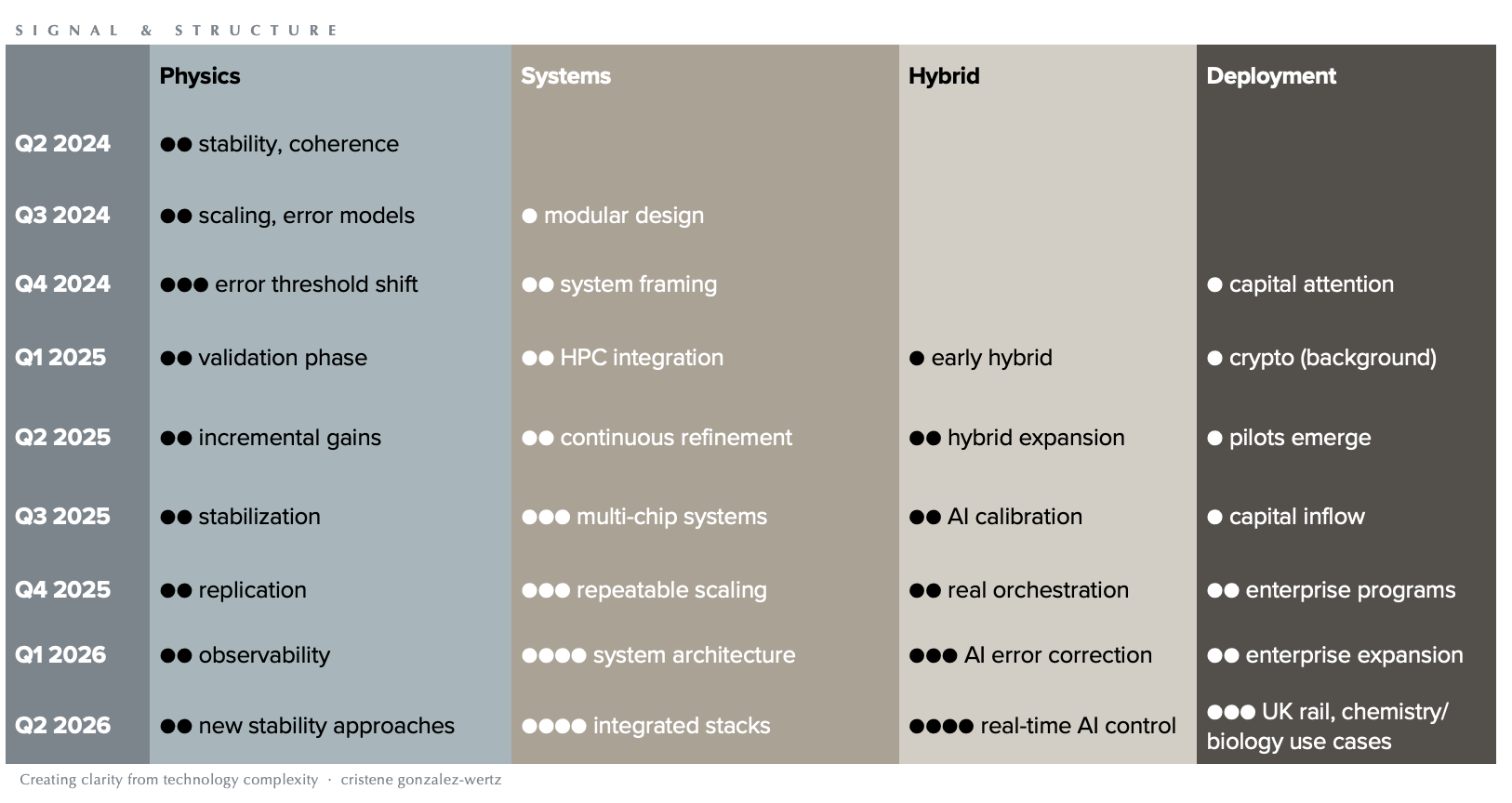
We needed to prove the physics, then development systems, pursue integration and look to move use cases into proven value
Physics stabilizes first
systems built on top
Hybrid integration accelerates later.
Deployment appears last
5. What each layer is actually doing
Physics becoming predictable (not “solved”)
This is where I tread lightly. The last few years have not “solved” quantum physics. But they have made it more engineering-friendly:
A better understanding of error rates and decoherence
Improved error correction approaches
More predictable scaling behavior in certain architectures
The important shift is not perfection. It is reliability at the margin. Enough stability to build systems on top of.
Systems, the real center of gravity
This is where the story changes. The focus has moved from individual qubits to:
How quantum processors are linked
How error correction is handled in real time
How quantum interacts with classical compute
This is the emergence of quantum as architecture, not experiment.
If physics made quantum possible, systems are making it usable.
Hybrid: the inflection layer
This is the layer that is moving fastest. Aparna Prabhakar and I broached this in a presentation she gave at Quantum.Tech 3 years ago, so this feels like it’s about time.
Quantum is now being:
embedded into high-performance computing workflows
paired with AI for calibration and control
orchestrated alongside classical systems
AI in particular is playing a new role: not just as a workload, but as a control mechanism. That changes how quantum systems behave in practice.
Deployment: early, uneven, but real
This layer is still forming, and it’s important not to overstate it.
But there are real signals:
transportation optimization (UK rail example)
chemistry and biology simulation breakthroughs
early enterprise pilots in optimization and materials
Notice what’s not leading this layer right now: cryptography. We've discussed cryptography use cases for years. While still important, it has not driven recent momentum, becoming background noise until recently.
What is emerging instead are operational use cases, even if still narrow. These extend actual in-practice applications.
6. What ties it all together
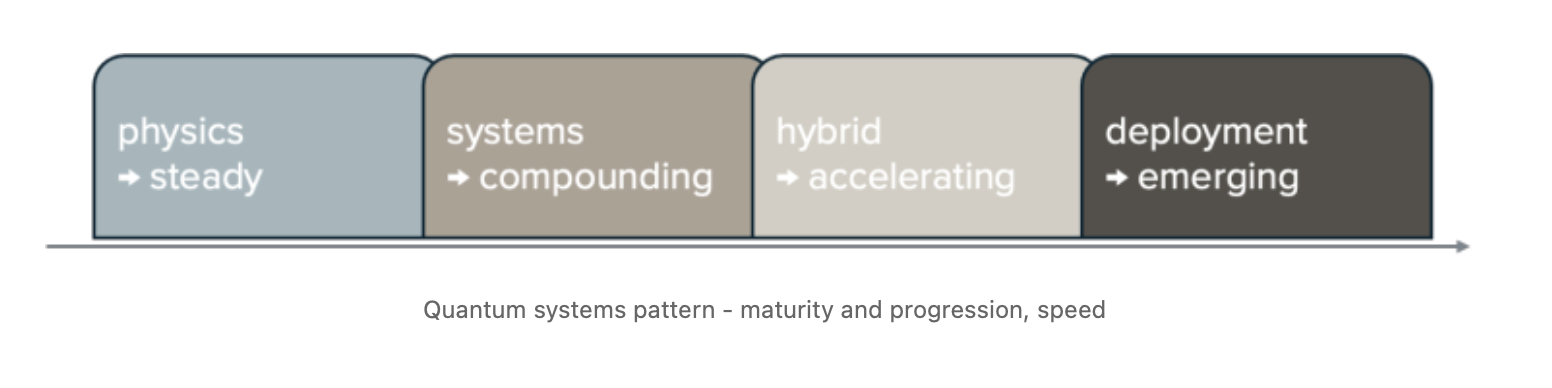
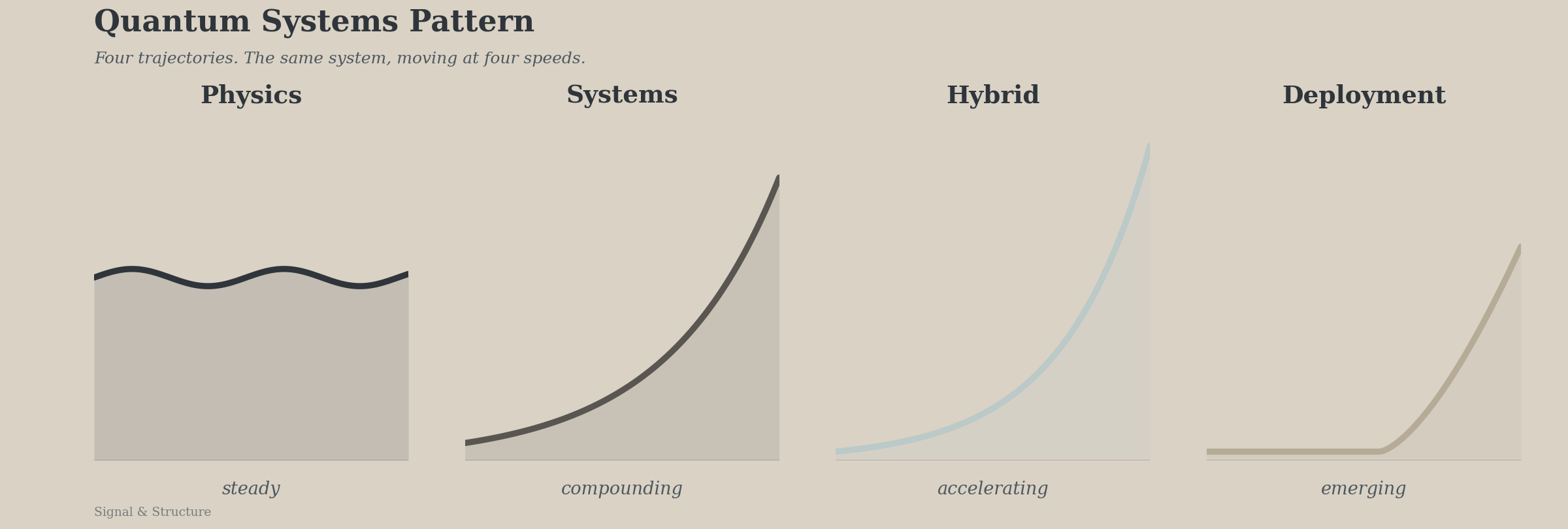
If you compress this into a single pattern:
Quantum systems pattern - maturity and progression, speed
The system does not move evenly. It builds.
Where we are now
The reason the last 4–8 weeks feel different is simple: For the first time, all four layers are active at once.
Physics is stable enough.
Systems are structured enough.
Hybrid integration is accelerating.
Deployment is visible
That combination creates momentum that feels like acceleration.
What this is not
This is not: a sudden breakthrough. Nor is it a single company winning (but there are a few places to lay your bets, if you ask me, I admit my bias.). We don’t have a clean “quantum advantage” moment.
What this is
This is the beginning of quantum as a system. Not perfect. Not universal. Not yet scaled. But increasingly: connected, orchestrated and usable in constrained domains. In other words, dare I say practical?
The strategist’s takeaway
If this is truly a coordination curve, then the signals to pay attention to are not bigger qubit counts. They are:
Questions to ask
where is quantum integrating into existing workflows?
which problems benefit from hybrid quantum-classical approaches today, not theoretically?
who is building systems that can be operated, not just demonstrated?
what use cases are moving from pilot to something repeatable?
Actions to take
track hybrid architectures, not standalone breakthroughs
prioritize partners who can orchestrate across systems
focus on narrow, high-value problems where constraints are clear
watch for patterns that scale, not one-off successes
